EMT Practice Test

1. Question Content...


Question List

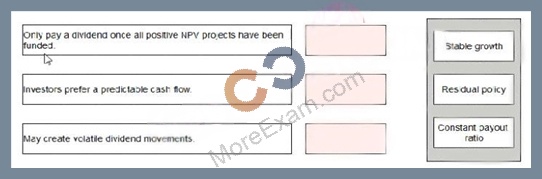
Question1: Select the most appropriate divided for each of the following statements:
Question2: Company W has received an unwelcome takeover bid from Company B.
The offer is a share exchange of 3 shares in Company B for 5 shares in Company W or a cash alternative of $5.70 for each Company W share.
Company B is approximately twice the size of Company W based on market capitalisation. Although the two companies have some common business interested the main aim of the bid is diversification for Company B.
Company W has substantial cash balances which the directors were planning to use to fund an acquisition.
These plans have not been announced to the market.
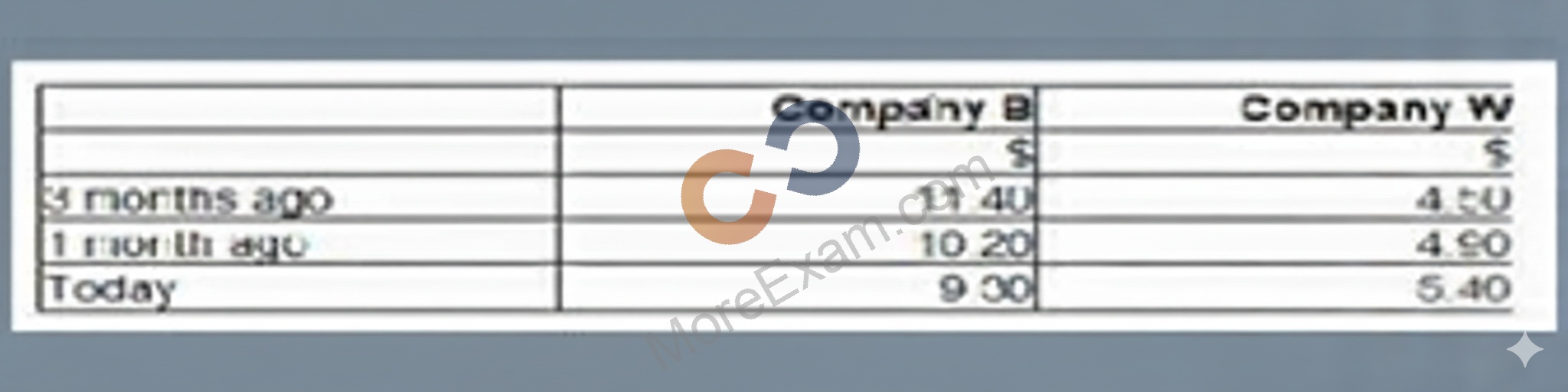
The following share price information is relevant.

Which of the following would be the most appropriate action by Company W's directors following receipt of this hostile bid?

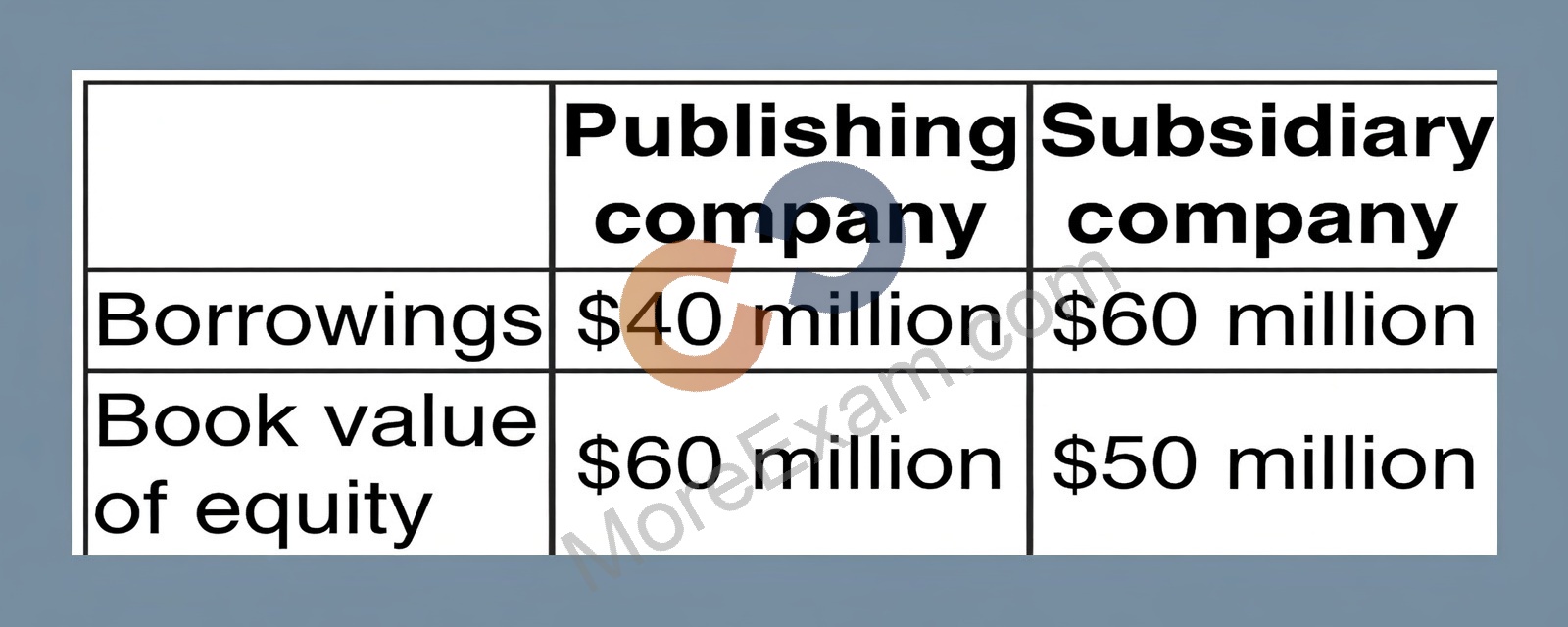
Question3: A listed publishing company owns a subsidiary company whose business activity is training.
It wishes to dispose of the subsidiary company.
The following information is available:

The board of the publishing company believe that the value of the subsidiary company, and hence the value of the equity invested in it, can be determined by calculating the present value of the subsidiary's free cashflows.
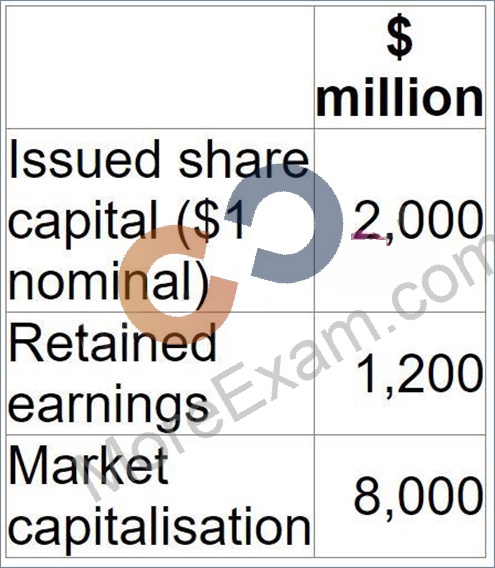
Which of the following is the most appropriate discount rate to use when determining the enterprise value of the company?

Question4: A company's Board of Directors is considering raising a long-term bank loan incorporating a number of covenants.
The Board members are unsure what loan covenants involve.
Which THREE of the following statements regarding loan covenants are true?

Question5: A company's current earnings before interest and taxation are $5 million.
These are expected to remain constant for the forseeable future.
The company has 10 million shares in issue which currently trade at $3.60.
It also has a $10 million long term floating rate loan.
The current interest rate on this loan is 5%.
The company pays tax at 20%.
The company expects interest rates to increase next year to 6% and it's Price/Earnings (P/E) ratio to move to 9.5 times by the end of next year.
What percentage reduction in the share price will occur by the end of next year if the interest rate increase and the P/E movement both occur?

Question6: Company A is a listed company that produces pottery goods which it sells throughout Europe. The pottery is then delivered to a network of self employed artists who are contracted to paint the pottery in their own homes.
Finished goods are distributed by network of sales agents.The directors of Company A are now considering acquiring one or more smaller companies by means of vertical integration to improve profit margins.
Advise the Board of Company A which of the following acquisitions is most likely to achieve the stated aim of vertical integration?

Question7: Company A is based in country A with the AS as its functional currency. It expects to receive BS20 million from Company B in settlement of an export invoice.
The current exchange rate is A$1 =B$2 and the daily standard deviation of this exchange rate = 0 5% What is the one-day 95% VaR in AS?

Question8: B has a S3 million loan outstanding on which the interested rate is reset every 6 months for the following 6 month and the interested is payable at the end of that 6 month period. The next 6 monthly reset period starts in
3 months and the treasurer of B thinks interested rates are likely to raise between and then.
Current 6-month rates are 6.4% and the treasurer can get a rate of 6.9% for a 6-month forward rate agreement (FRA) starting in 3 months time. By transacting an TRA the treasurer can lock in a rate today of 6.9%.
If interested rates are 7.5% in 3 months' time, what will the net amount payable be?
Give your answer to the nearest thousand dollars.

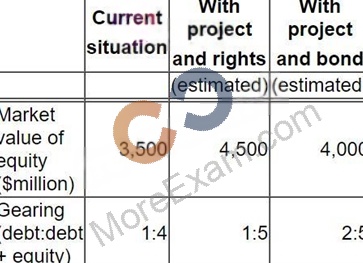
Question9: A company is currently all-equity financed.
The directors are planning to raise long term debt to finance a new project.
The debt:equity ratio after the bond issue would be 40:60 based on estimated market values.
According to Modigliani and Miller's Theory of Capital Structure without tax, the company's cost of equity would:

Question10: A company has a covenant on its 5% long term corporate bond.
* Covenant - The earnings must not fall below $7 million
The bond has a nominal value of $60 million.
It is currently trading at 80% of its nominal value.
The projected earnings before interest and taxation for next year are $11.5 million.
The company retains 80% of its earnings. It pays tax at 20%.
Advise the Board of Directors which of the following covenant conditions will apply next year?

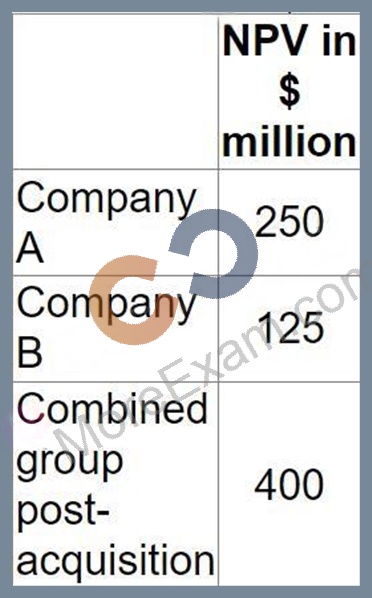
Question11: Company A is planning to acquire Company B by means of a cash offer. The directors of Company B are prepared to recommend acceptance if a bid price can be agreed. Estimates of the net present value (NPV) of future cash flows for the two companies and the combined group post acquisition have been prepared by Company A's accountant. There are as follows:

What is the maximum price that Company A should offer for the shares in Company B?
Give your answer to the nearest $ million

Question12: Providers of debt finance often insist on covenants being entered into when providing debt finance for companies.
Agreement and adherence to the specific covenants is often a condition of the loan provided by the lender.
Which THREE of the following statements are true in respect of covenants?

Question13: The competition authorities are investigating the takeover of Company Z by a larger company, Company
Y.
Both companies are food retailers.
The takeover terms involve using a part cash, part share exchange means of payment.
Company Z is resisting the bid, arguing that it undervalues its business, while lobbying extensively among politicians to sway public opinion against the bidder.
Which of the following actions by Company Y is most likely to persuade the competition authorities to approve the acquisition?

Question14: Which of the following statements best describes a residual dividend policy?
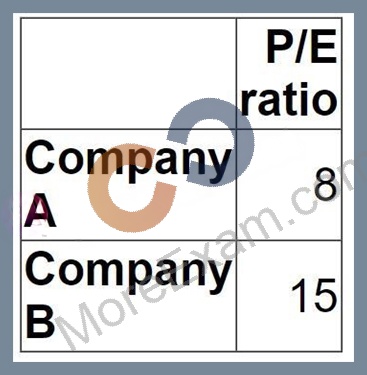
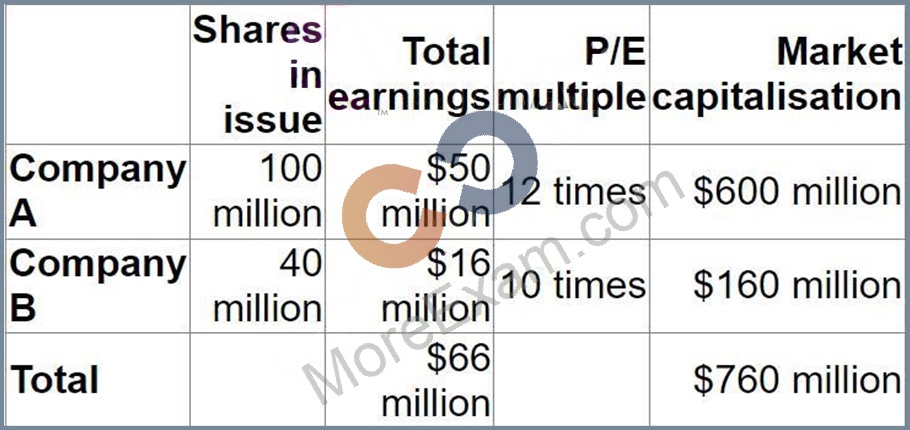
Question15: Two companies that operate in the same industry have different Price/Earnings (P/E) ratios as follows:

Which of the following is the most likely explanation of the different P/E ratios?

Question16: A company enters into a floating rate borrowing with interest due every 12 months over the five year life of the borrowing.
At the same time, the company arranges an interest rate swap to swap the interest profile on the borrowing from floating to fixed rate.
These transactions are designated as a hedge for hedge accounting purposes under IAS 39 Financial Instruments: Recognition and Measurement.
Assuming the hedge is considered to be effective, how would the swap be accounted for 12 months later?

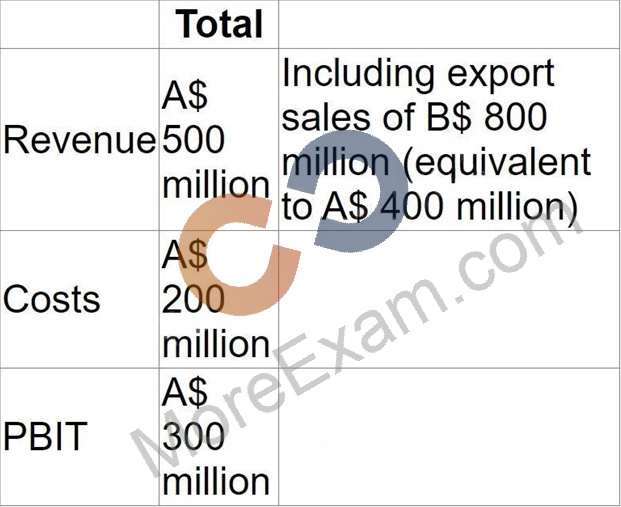
Question17: A company aims to increase profit before interest and tax (PBIT) each year.
The company reports in A$ but has significant export sales priced in B$.
All other transactions are priced in A$.
In 20X1, the company reported:

In 20X2, the only changes expected are:
* An increase in export prices of 10%, but no change to units sold.
* A rise in the value of the B$ to A$/B$ 2.500 (that is, A$ 1 = B$ 2.5) Is it likely that the company would still meet its objective to grow PBIT between 20X1 and 20X2?

Question18: Company A, a listed company, plans to acquire Company T, which is also listed.
Additional information is:
* Company A has 100 million shares in issue, with market price currently at $8.00 per share.
* Company T has 90 million shares in issue,. with market price currently at $5.00 each share.
* Synergies valued at $60 million are expected to arise from the acquisition.
* The terms of the offer will be 2 shares in A for 3 shares in B.
Assuming the offer is accepted and the synergies are realised, what should the post-acquisition price of each of Company A's shares be?
Give your answer to two decimal places.

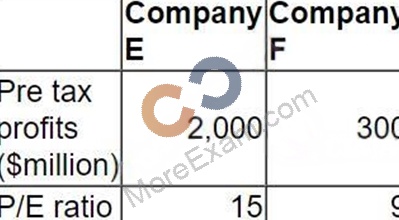
Question19: Company E is a listed company. Its directors are valuing a smaller listed company, Company F, as a possible acquisition.
The two companies operate in the same markets and have the same business risk.
Relevant data on the two companies is as follows:

Both companies are wholly equity financed and both pay corporate tax at 30%.
The directors of Company E believe they can "bootstrap" Company F's earnings to improve performance.
Calculate the maximum price that Company E should offer to Company F's shareholders to acquire the company.
Give your answer to the nearest $million.

Question20: The Board of Directors of a listed company have decided that it needs to increase its equity capital to ensure it is in a more stable financial position.
The shareholder profile is a mix of institutional and individual small shareholders.
The board is considering either:
* A scrip dividend
* A zero dividend
Which THREE of the following would be considered disadvantages of a scrip dividend compared to a zero dividend?

Question21: A profitable company wishes to dispose of a loss-making division that generated negative free cashflow in the last financial year.
The division requires significant new investment to return it to profitability.
Which of the following valuation approaches is likely to be the most useful to the company when negotiating the sales price?

Question22: A company has identified potential profitable investments that would require a total of S50 million capital expenditure over the next two years The following information is relevant.
* The company has 100 million shares in issue and has a market capitalisation of S500 million
* It has a target debt to equity ratio of 40% based on market values This ratio is currently 30%
* Earnings for the current year are expected to be S1 00 million
* Its last dividend payment was $1 per share One of the company's objectives is to increase dividends by at least 10% each year
* The company has no cash reserves
Which of the following is the most suitable method of financing to meet the company's requirements?

Question23: Which of the following statements about IFRS 7 Financial Instruments: Disclosures is true?

Question24: Using the CAPM, the expected return for a company is 10%. The market return is 7% and the risk free rate is
1%.
What does the beta factor used in this calculation indicate about the risk of the company?

Question25: Which THREE of the following long term changes are most likely to increase the credit rating of a company?

Question26: A company plans to cut its dividend but is concerned that the share price will fall. This demonstrates the
_____________ effect

Question27: Company B is an all equity financed company with a cost of equity of 10%.
It is considering issuing bonds in order to achieve a gearing level of 20% debt and 80% equity.
These bonds will pay a coupon rate of 5% and have an interest yield of 6%.
Company B pays corporate tax at the rate of 25%.
According to Modigliani and Miller's theory of capital structure with tax, what will be Company B's new cost of equity?

Question28: A company is considering the issue of a convertible bond compared to a straight bond issue (non- convertible bond).
Director A is concerned that issuing a convertible bond will upset the shareholders for the following reasons:
* it will dilute their control
* the interest payments will be higher therefore reducing liquidity
* it will increase the gearing ratio therefore increasing financial risk Director B disagrees, and is preparing a board paper to promote the issue of the convertible bond rather than a non-convertible.
Advise the Director B which THREE of the following statements should be included in his board paper to promote the issue of the convertible bond?

Question29: Companies A, B, C and D:
* are based in a country that uses the K$ as its currency.
* have an objective to grow operating profit year on year.
* have the same total levels of revenue and cost.
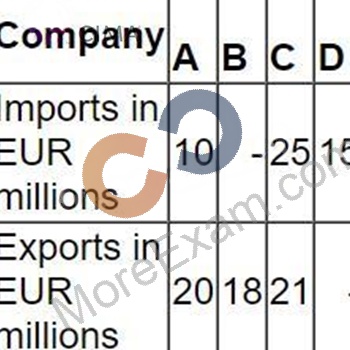
* trade with companies or individuals in the eurozone. All import and export trade with companies or individuals in the eurozone is priced in EUR.
Typical import/export trade for each company in a year are as follows:

Which company's growth objective is most sensitive to a movement in the EUR/K$ exchange rate?

Question30: A company has:
* A price/earnings (P/E) ratio of 10.
* Earnings of $10 million.
* A market equity value of $100 million.
The directors forecast that the company's P/E ratio will fall to 8 and earnings fall to $9 million.
Which of the following calculations gives the best estimate of new company equity value in $ million following such a change?

Question31: A new company was set up two years ago using the personal financial resources of the founders.
These funds were used to acquire suitable premises.
The company has entered into a long-term lease on the premises which are not yet fully fitted out.
The founders are considering requesting loan finance from the company's bank to fund the purchase of custom-made advanced technology equipment.
No other companies are using this type of equipment.
The company expects to continue to be profitable for the forseeable future.
It re-invests some of its surplus cash in on-going essential research and development.
Which THREE of the following features are likely to be considered negatives by the bank when assessing the company's credit-worthiness?

Question32: Listed company R is in the process of making a cash offer for the equity of unlisted company S.
Company R has a market capitalisation of $200 million and a price/earnings ratio of 10.
Company S has a market capitalisation of $50 million and earnings of $7 million.
Company R intends to offer $60 million and expects to be able to realise synergistic benefits of $20 million by combining the two businesses. This estimate excludes the estimated $8 million cost of integrating the two businesses.
Which of the following figures need to be used when calculating the value of the combined entity in $ millions?

Question33: Company A operates in country A with the AS as its functional currency. Company A expects to receive BS500.000 in 6 months' time from a customer in Country B which uses the B$.
Company A intends to hedge the currency risk using a money market hedge The following information is relevant:

What is the AS value of the BS expected receipt in 6 months' time under a money market hedge?

Question34: B has a S3 million loan outstanding on which the interested rate is reset every 6 months for the following 6 month and the interested is payable at the end of that 6 month period. The next 6 monthly reset period starts in
3 months and the treasurer of B thinks interested rates are likely to raise between and then.
Current 6-month rates are 6.4% and the treasurer can get a rate of 6.9% for a 6-month forward rate agreement (FRA) starting in 3 months time. By transacting an TRA the treasurer can lock in a rate today of 6.9%.
If interested rates are 7.5% in 3 months' time, what will the net amount payable be?
Give your answer to the nearest thousand dollars.

Question35: An entity prepares financial statements to 31 December each year. The following data applies:
1 December 20X0
* The entity purchased some inventory for $400,000.
* In order to protect the inventory against adverse changes in fair value the entity entered into a futures contract to sell the inventory for a fixed price on 31 January 20X1.
* The entity designated this contract as a fair value hedge of the value of the inventory.
31 December 20X0
* The inventory had a fair value of $480,000 and the futures contract had a fair value of $75,000 (a financial liability).
What will be the impact on the statement of profit or loss and other comprehensive income for the year ended
31 December 20X0 in respect of the change in the value of the inventory and the futures contract?

Question36: Listed Company A has prepared a valuation of an unlisted company. Company B.
to achieve vertical integration Company A is intending to acquire a controlling interest in the equity of Company B and therefore wants to value only the equity of Company B.
The assistant accountant of Company A has prepared the following valuation of Company B's equity using the dividend valuation model (DVM):
Where:
* S2 million is Company B's most recent dividend
* 5% is Company B's average dividend growth rate over the last 5 years
* 10% is a cost of equity calculated using the capital asset pricing model (CAPM), based on the industry average beta factor

Which THREE of the following are valid criticisms of the valuation of Company B's equity prepared by the assistant accountant?

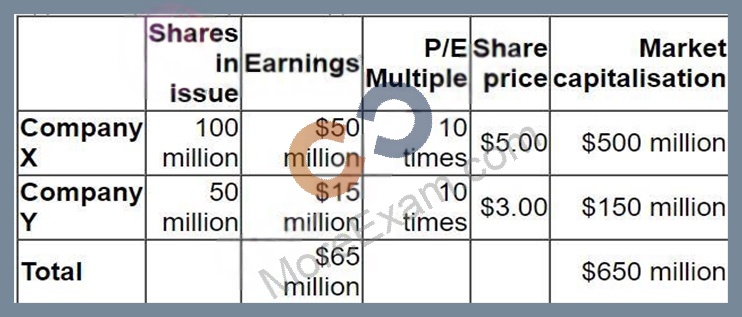
Question37: Company X plans to acquire Company Y.
Pre-acquisition information:

Post-acquisition information:
Total combined earnings are expected to increase by 10%
Total combined P/E multiple will remain at 10 times
Which of the following share-for-share exchanges will result in an increase of 10% in Company X's share price post-acquisition?

Question38: A company generates and distributes electricity and gas to households and businesses.
Forecast results for the next financial year are as follows:

The Industry Regulator has announced a new price cap of $2.00 per Kilowatt.
The company expects this to cause consumption to rise by 15% but costs would remained unaltered.
The price cap is expected to cause the company's net profit to fall to:

Question39: A company raised fixed rate bank finance together with an interest rate swap for the same term and same principal value to pay floating receive fixed rate interest on an annual basis.
Which THREE of the following statements are correct?

Question40: A venture capitalist invests in a company by means of buying:
* 9 million shares for $2 a share and
* 8% bonds with a nominal value of $2 million, repayable at par in 3 years' time.
The venture capitalist expects a return on the equity portion of the investment of at least 20% a year on a compound basis over the first 3 years of the investment.
The company has 10 million shares in issue.
What is the minimum total equity value for the company in 3 years' time required to satisify the venture capitalist's expected return?
Give your answer to the nearest $ million.
$ million.

Question41: Company Z wishes to borrow $50 million for 10 years at a fixed rate of interest.
Two alternative approaches are being considered:
A: Issue a 10 year bond at a fixed rate of 6%, or B: Borrow from the bank at Libor +2.5% for a 10 year period and simultaneously enter into a 10 year interest rate swap.
Current 10 year swap rates against Libor are 4.0% - 4.2%.
What is the difference in the net interest cost between the two alternative approaches?

Question42: A company is considering either exporting its product directly to customers in a foreign country or establishing a manufacturing subsidiary in that country.
The corporate tax rate in the company's own country is 20% and 25% tax depreciation allowances are available.
Which THREE of the following would be considered advantages of establishing the subsidiary in the foreign country?

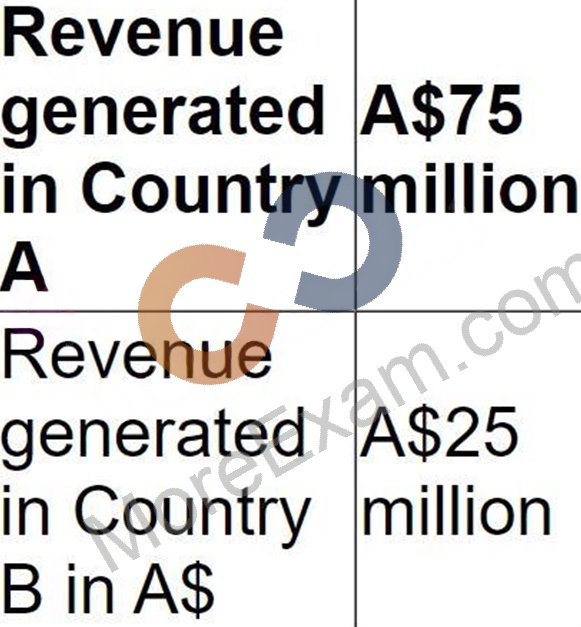
Question43: Company X is based in Country A, whose currency is the A$.
It trades with customers in Country B, whose currency is the B$.
Company X aims to maintain its revenue from exports to Country B at 25% of total revenue.
Company A has the following forecast revenue:

The forecast revenue from Country B has assumed an exchange rate of A$1/B$2, that is A$1 = B$2.
If the B$ depreciates against the A$ by 10%, the ratio of revenue generated from Country B as a percentage of total revenue will:

Question44: Company B is an all equity financed company with a cost of equity of 10%.
It is considering issuing bonds in order to achieve a gearing level of 20% debt and 80% equity.
These bonds will pay a coupon rate of 5% and have an interest yield of 6%.
Company B pays corporate tax at the rate of 25%.
According to Modigliani and Miller's theory of capital structure with tax, what will be Company B's new cost of equity?
A)

B)

C)

D)

Question45: A company wishes to raise new finance using a rights issue to invest in a new project offering an IRR of 10% The following data applies:
* There are currently 1 million shares in issue at a current market value of $4 each.
* The terms of the rights issue will be $3.50 for 1 new share for 5 existing shares.
* The company's WACC is currently 8%.
What is the yield-adjusted theoretical ex-rights price (TERP)?
Give your answer to 2 decimal places.
$ ?

Question46: A company has accumulated a significant amount of excess cash which is not required for investment for the foreseeable future.
It is currently on deposit, earning negligible returns.
The Board of Directors is considering returning this excess cash to shareholders using a share repurchase programme.
The majority of shareholders are individuals with small shareholdings.
Which THREE of the following are advantages of the company undertaking a share repurchase programme?

Question47: A company has some 7% coupon bonds in issue and wishes to change its interest rate profile.
It has decided to do this by entering into a plain coupon interest rate swap with it's bank.
The bank has quoted a swap rate of: 6.0% - 6.5% fixed against LIBOR.
What will the company's new interest rate profile be?

Question48: Company M plans to bid for Company J.
Company M has 20 million shares in issue and a current share price of $10.00 before publicly announcing the planned takeover. Company J has 10 million shares in issue and a current share price of $4.00.
The directors of Company M are considering an all-share bid of 1 Company M shares for 2 Company J shares.
Synergies worth $20m are expected from the acquisition.
What is the likely change in wealth for Company M's shareholders (in total) if the bid is accepted?
Give your answer to the nearest $ million.

Question49: It is now 1 January 20X0.
Company V, a private equity company, is considering the acquisition of 40% of the equity of Company A for a total amount of $15 million.
Company A has been established to develop a new type of engine which will be launched at the end of 20X1.
Company A is forecasting that the new engine will result in free cash flows to equity of $2m in its first year of operation and that this will rise by 8% per year for the foreseeable future.
The new engine is the only commercial activity that Company A is involved in.
Company V intends to sell its stake in Company A when the new engine is launched.
Company A has a cost of equity of 12%.
Assuming that Company V receives an amount that reflects the present value of their shares in company A.
what is the estimated annual rate of return to Company V from this investment? (To the nearest %)

Question50: A company is preparing an integrated report according to the International <IR> Framework as issued by the International Integrated Reporting Council.
Which THREE of the following should be included in the report?

Question51: The primary objective of a public sector entity is to ensure value for money is generated.
Value for money is defined as performing an activity so as to simultaneously achieve economy, efficiency and effectiveness Efficiency is defined as:

Question52: Company A is proposing a rights issue to finance a new investment. Its current debt to equity ratio is 10%.
Which TWO of the following statements are true?

Question53: The Board of Directors of a listed company wish to estimate a reasonable valuation of the entire share capital of the company in the event of a takeover bid.
The company's current profit before taxation is $4.0 million.
The rate of corporate tax is 25%.
The average P/E multiple of listed companies in the same industry is 8 times current earnings.
The P/E multiple of recent takeovers in the same industry have ranged from 9 times to 10 times current earnings.
The average P/E multiple of the top 100 companies on the stock market is 15 times current earnings.
Advise the Board of Directors which of the following is a reasonable estimate of a range of values of the entire share capital in the event of a bid being made for the whole company?

Question54: A company plans to acquire new machinery.
It has two financing options; buy outright using a bank loan, or a finance lease.
Which of the following is an advantage of a finance lease compared with a bank loan?

Question55: The Board of Directors of a small listed company engaged in exploration are currently considering the future dividend policy of the company. Exploration is considered a high-risk business and consequently the company has a low level of debt finance.
Forecasts indicate a period of profit fluctuation in the next few years as the company is planning to embark on a major capital investment project. Debt finance is unlikely to be available due to the project's high business risk.
Which THREE of the following are practical considerations when determining the company's dividend/retention policy?

Question56: Company A needs to raise AS500 mi lion to invest in a new project and is considering using a pub ic issue of bonds to finance the investment.
Which THREE of the following statements-relating to this bond issue are true?

Question57: The value of a call option will increase because of:
Question58: Which THREE of the following are considered in detail in IFRS 7 Financial Instruments: Disclosures?

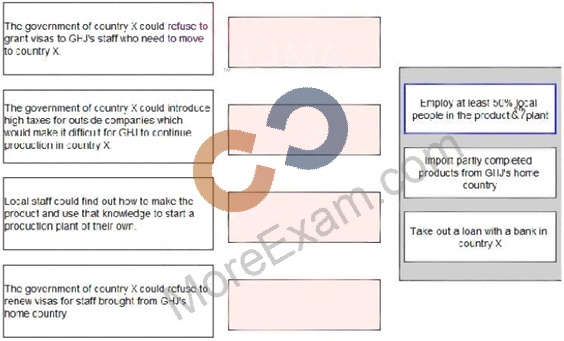
Question59: CI IJ has decided to move its production plant to overseas country X.
This would make the product cheaper to produce. The technology used to make the product is very advanced and some of the skilled staff would have to move to country X.
The Production Director has identified that there are some political risks in moving to county X.
For each of the political risks of moving to country X shown below, select the correct method for reducing the risk.

Question60: A listed company is financed by debt and equity.
If it increases the proportion of debt in its capital structure it would be in danger of breaching a debt covenant imposed by one of its lenders.
The following data is relevant:

The company now requires $800 million additional funding for a major expansion programme.
Which of the following is the most appropriate as a source of finance for this expansion programme?

Question61: Which THREE of the following would be most important if a hospital wishes to review the effectiveness of its services?

Question62: Which TIIRCC of the following are most likely be primary objectives for a newly established, unincorporated entity in the service sector?

Question63: Company F's current profit before interest and taxation is $5.0 million.
It has a 10% long-term corporate bond in issue with a nominal value of $10 million.
Corporate tax is paid at 25%.
The industry average P/E multiple is 10.
Company X has made an approach to acquire the entire share capital of Company F for $30 million.
Company X has announced that anticipated synergies (after interest and taxation) arising from its acquisition of Company F will be $1 million each year in perpetuity.
Advise the Board of Directors of Company F if the bid should be accepted, based on the above information?

Question64: Company A plans to acquire Company B.
Both firms operate as wholesalers in the fashion industry, supplying a wide range of ladies' clothing shops.
Company A sources mainly from the UK, Company B imports most of its supplies from low-income overseas countries.
Significant synergies are expected in management costs and warehousing, and in economies of bulk purchasing.
Which of the following is likely to be the single most important issue facing Company A in post-merger integration?

Question65: PYP is a listed courier company. It is looking to raise new finance to fit each of its delivery vans with new equipment to allow improved parcel tracking for customers The senior management team of PYP have decided on a 10-year secured bond to finance this investment- Which TWO of the following variables are most likely to decrease the yield to maturity of the bond?

Question66: A venture capitalist invests in a company by means of buying:
* 9 million shares for $2 a share and
* 8% bonds with a nominal value of $2 million, repayable at par in 3 years' time.
The venture capitalist expects a return on the equity portion of the investment of at least 20% a year on a compound basis over the first 3 years of the investment.
The company has 10 million shares in issue.
What is the minimum total equity value for the company in 3 years' time required to satisify the venture capitalist's expected return?
Give your answer to the nearest $ million.
$ million.

Question67: Companies L. M N and O:
* are based in a country that uses the RS as its currency
* have an objective to grow operating profit year on year
* have the same total levels of revenue and cost
* trade with companies or individuals in the United States. All import and export trade with companies or individuals in the United States is priced in US$.
Typical import/export trade for each company in a year are as follows:

Which company's growth objective is most sensitive to a movement in the USS / RS exchange rate?

Question68: Company B is an all equity financed company with a cost of equity of 10%.
It is considering issuing bonds in order to achieve a gearing level of 20% debt and 80% equity.
These bonds will pay a coupon rate of 5% and have an interest yield of 6%.
Company B pays corporate tax at the rate of 25%.
According to Modigliani and Miller's theory of capital structure with tax, what will be Company B's new cost of equity?
A)

B)

C)

D)

Question69: A project requires an initial outlay of $2 million which can be financed with either a bank loan or finance lease.
The company will be responsible for annual maintenance under either option.
The tax regime is:
* Tax depreciation allowances can be claimed on purchased assets.
* If leased using a finance lease, tax relief can be claimed on the interest element of the lease payments and also on the accounting depreciation charge.
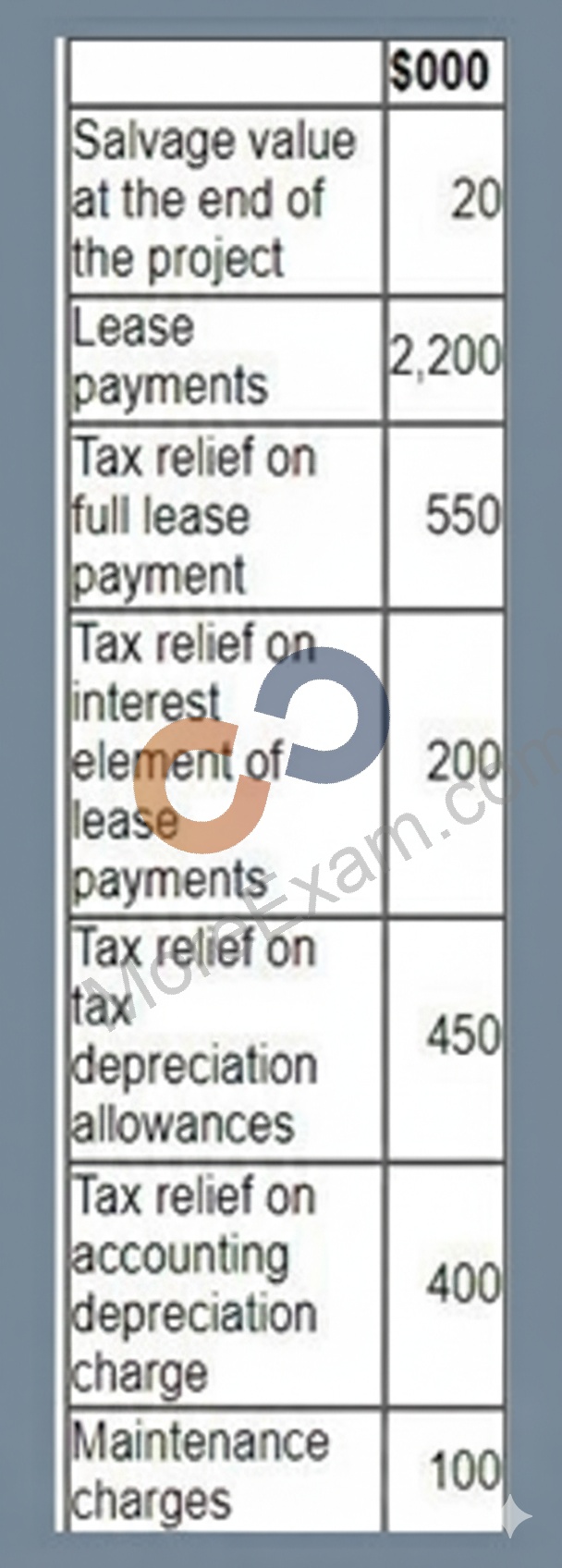
The trainee management accountant has begun evaluating the lease versus buy decision and has produced the following data. He is not confident that all this information is relevant to this decision.

Using only the relevant data, which of the following is correct?

Question70: A listed company with a growing share price plans to finance a four-year research project with debt.
The main criterion for the finance is to minimise the annual cashflow payments on the debt.
The research will be sold at the end of the project.
Which of the following would be the most suitable financing method for the company?

Question71: A company is owned by its five directors who want to sell the business.
Current profit after tax is $750,000.
The directors are currently paid minimal salaries, taking most of their incomes as dividends.
After the company is sold, directors' salaries will need to be increased by $50,000 each year in total.
A suitable Price/Earnings (P/E) ratio is 7, and the rate of corporate tax is 20%.
What is the value of the company using a P/E valuation?

Question72: A company's Board of Directors wishes to determine a range of values for its equity.
The following information is available:
Estimated net asset values (total asset less total liabilities including borrowings):
* Net book value = $20 million
* Net realisable value = $25 million
* Free cash flows to equity = $3.5 million each year indefinitely, post-tax.
* Cost of equity = 10%
* Weighted Average Cost of Capital = 7%
Advise the Board on reasonable minimum and maximum values for the equity.

Question73: The ex div share price of Company A's shares is $.3.50
An investor in Company A currently holds 2,000 shares.
Company A plans to issue a script divided of 1 new shares for every 10 shares currently held.
After the scrip divided, what will be the total wealth of the shareholder?
Give your answer to the nearest whole $.

Question74: An unlisted software development company has recently reported disappointing results. This was partly due to weak economic conditions but also because of its poor competitive position. The company has a number of exciting development opportunities which would enable it to achieve significant future growth. The company's growth potential has been hindered by its inability to secure sufficient new finance.
To enable the company raise new finance the Directors are considering working forwards an IPO in 10 years and accepting finance from a venture capitalist in order support in the intervening period.
The directors are keen to retain a controlling stake in the company and full representation on the board. They therefore require venture capitalists to provide funds as a mix of debt and equity and not soley equity finance.
Which THREE of the following are most likely to disrupt the directors' plans to use venture capital finance?

Question75: A company generates operating profit of $17.2 million, and incurs finance costs of $5.7 million.
It plans to increase interest cover to a multiple of 5-to-1 by raising funds from shareholders to repay some existing debt. The pre-tax cost of debt is fixed at 5%, and the refinancing will not affect this.
Assuming no change in operating profit, what amount must be raised from shareholders?
Give your answer in $ millions to the nearest one decimal place.

Question76: On 1 January 20X1, a company had:
* Cost of equity of 10 0%.
* Cost of debt of 5.0%
* Debt of $100Mmilion
* 100 million $1 shares trading at $4.00 each.
On 1 February 20X1:
* The company's share police fell to $3.00.
* Debt and the cost of debt remained unchanged
The company does not pay tax.
Under Modigliani and Miller's theory without lax. what is the best estimate of the movement in the cost of equity as a result of the fall in ne share price?

Question77: The directors of a financial services company need to calculate a valuation of their company's equity in preparation for an upcoming initial Public Offering (IPO) of shares. At a recent board meeting they discussed the various methods of business valuation.
The Chief Executive suggested using a Price-earing (P./E) method of valuation, but the finance Director argued that a valuation based on forecast cash flows to equity would be more appropriate.
Which THREE of the following are advantages of valuation based on forecast cash flows to equity, compared to a valuating using a price earnings methods?

Question78: Company A plans to acquire Company B in a 1-for-1 share exchange.
Pre-acquisition information is as follows:

Post-acquisition information is as follows:
* Annual earnings are expected to increase by $4 million.
* The P/E multiple of the combined company is expected to be 12 times.
If the acquisition proceeds, what is the expected percentage increase in the post acquisition share price of Company A?

Question79: A company is based in Country Y whose functional currency is Y$. It has an investment in Country Z whose functional currency is Z$.
This year the company expects to generate Z$ 10 million profit after tax.
Tax Regime:
* Corporate income tax rate in country Y is 50%
* Corporate income tax rate in country Z is 20%
* Full double tax relief is available
Assume an exchange rate of Y$ 1 = Z$ 5.
What is the expected profit after tax in Y$ if the Z$ profit is remitted to Country Y?

Question80: Company A plans to acquire a minority stake in Company B.
The last available share price for Company B was $0.60.
Relevant data about Company B is as follows:
* A dividend per share of $0.08 has just been paid
* Dividend growth is expected to be 2%
* Earnings growth is expected to be 4%
* The cost of equity is 15%
* The weighted average cost of capital is 13%
Using the dividend growth model, what would be the expected change in share price?

Question81: Company T has 1,000 million shares in issue with a current share price of $10 each.
Company V has 300 million shares in issue with a current share price of $5 each.
Company T is considering acquiring Company V.
Total synergy gains of $100 million have been estimated.
The purchase of Company V's shares would be by cash at a 10% premium above the current share price.
In seeking approval for the acquisition, the likely reaction from T's shareholders will be:

Question82: A company has convertible bonds in issue.
The following debt is apply (31 December 20X0):
* Conversion ratio- 20 shares for each $130 bond.
* Current share price - $4 50
* Expected annual growth in share price - 5%
Advise the bond Holder at which date the convers on would be worthwhile?

Question83: On 31 October 20X3:
* A company expected to agree a foreign currency transaction in January 20X4 for settlement on 31 March
20X4.
* The company hedged the currency risk using a forward contract at nil cost for settlement on 31 March
20X4.
* The transaction was correctly treated as a cash flow hedge in accordance with IAS 39 Financial Instruments: Recognition and Measurement.
On 31 December 20X3, the financial year end, the fair value of the forward contract was $10,000 (asset).
How should the increase in the fair value of the forward contract be treated within the financial statements for the year ended 31 December 20X3?

Question84: An entity prepares financial statements to 30 June.
During the year ended 30 June 20X2 the following events occurred:
1 July 20X1
* The entitiy borrowed $100 million at a variable rate of interest.
* In order to protect itself against the variability of its interest cashflows, the entity entered into a pay- fixed-receive-variable interest swap with annual settlements. The fair value of the swap on this date was zero.
30 June 20X2
* The entity received a net settlement of $2 million under the swap. After this net settlement, the fair value of the swap was $5 million - a financial asset.
The entity decides to use hedge accounting for this arrangement and has designated it as a cash flow hedge. The swap is a perfect hedge of the variability of the cash interest payments.
Which of the following describes the treatment of the settlement and the change in the fair value of the swap in the statement of profit or loss and other comprehensive income for the year ended 30 June
20X2?

Question85: Company C is a listed company. It is currently considering the acquisition of Company D.
The original founder of Company C currently owns 52% of the shares.
Alternative forms of consideration for Company D being considered are as follows:
* Cash payment, financed by new borrowing
* issue of new shares in Company C
Which of the following is an advantage of a cash offer over a share-for exchange from the viewpoint of the original founder of Company C?

Question86: LPM Company is based in Country C. whose currency is the CS
It has entered Into a contract to buy a machine in three months' time. The supplier is overseas and the payment is to be made in a different currency from the CS The treasurer at LPM Company is considering using a money market hedge to manage the transaction risk associated with a payment.
The assumptions of interest rate parity apply
Which THREE of the following statements concerning the use of a money market hedge for this supplier payment are correct*?

Question87: Which TIIRCC of the following are most likely to reduce the long term credit rating co a company?

Question88: A company has just received a hostile bid. Which of the following response strategies could be considered?

Question89: An unlisted company is attempting to value its equity using the dividend valuation model.
Relevant information is as follows:
* A dividend of $500,000 has just been paid.
* Dividend growth of 8% is expected for the foreseeable future.
* Earnings growth of 6% is expected for the foreseeable future.
* The cost of equity of a proxy listed company is 15%.
* The risk premium required due to the company being unlisted is 3%.
The calculation that has been performed is as follows:
Equity value = $540,000 / (0.18 - 0.08) = $5,400,000
What is the fault with the calculation that has been performed?

Question90: A large multi-divisional company in the food processing and distribution business is conducting a strategic review. The divisions all compete in the same market.
The sale of one of its underperforming food processing divisions to the divisional management team is currently being considered. The purchase by the divisional management team will require venture capital finance.
Which THREE of the following are likely to influence the multi-divisional company's decision on whether or not to sell the under-performing division to the management team?

Question91: KKL is a listed sports clothing company with three separate business units. KKL is seeking to sell TT', one of these business units TTP cwns a new. brand of trail running shoes that have Droved hugely popular with lone distance runners.
The management team of TTP are frustrated by the constraints imposes b/ KKL in managing tie brand and developing. the bus ness and they believe that TTF has huge growth potential.
The management team of TTP have approached KKL with a proposal to purchase 1~P through a management layout (MDO). KKL has accepted this proposal as TTP has not proved to be a good fit' with the rest of the business and has agreed on the selling price.
Which THREE of the following factors a-e mast Likely to affect the success of the MBO?

Question92: The following information relates to Company A's current capital structure:
Company A is considering a change in the capital structure that will increase gearing to 30:70 (Debt:Equity).
The risk -free rate is 3% and the return on the market portfolio is expected to be 10%.
The rate of corporate tax is 25%
Using the Capital Asset Pricing Model, calculate the cost of equity resulting from the proposed change to the capital structure.

Question93: A listed company plans to raise $350 million to finance a major expansion programme.
The cash flow projections for the programme are subject to considerable variability.
Brief details of the programme have been public knowledge for a few weeks.
The directors are considering two financing options, either a rights issue at a 20% discount to current share price or a long term bond.
The following data is relevant:

The company's share price has fallen by 5% over the past 3 months compared with a fall in the market of 3% over the same period.
The directors favour the bond option.
However, the Chief Accountant has provided arguments for a rights issue.
Which TWO of the following arguments in favour of a right issue are correct?

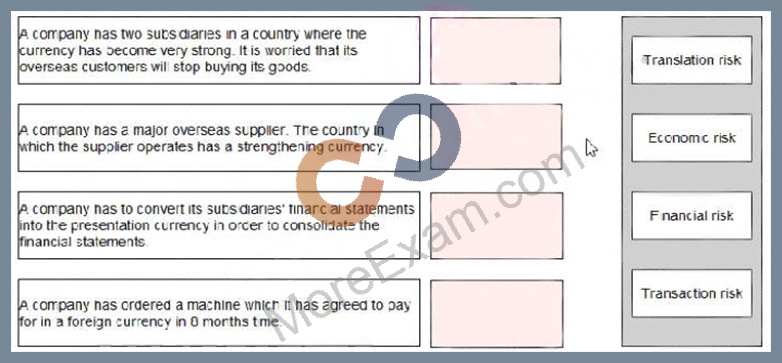
Question94: Select the category of risk for each of the descriptions below:

Question95: A company has announced a rights issue of 1 new share for every 4 existing shares.
Relevant data:
* The current market price per share is $10.00.
* Rights are to be issued at a 20% discount to the current price.
* The rate of return on the new funds raised is expected to be 10%.
* The rate of return on existing funds is 5%.
What is the yield-adjusted theoretical ex-rights price?
Give your answer to two decimal places.
$ ?

Question96: A company is planning to repurchase some of its shares. Relevant details are as follows:
* 100 million shares in issue
* Current share price $5
* 5 million shares to be repurchased
* 10% repurchase premium
* Repurchased shares to be cancelled
What would you expect the share price after the repurchase to be?
Give your answer to two decimal places.
$ ?

Question97: A company intends to sell one of its business units, Company R by a management buyout (MBO).
A selling price of $100 million has been agreed.
The managers are discussing with a bank and a venture capital company (VCC) the following financing proposal:
The VCC requires a minimum return on its equity investment in the MBO of 30% a year on a compound basis over 5 years.
What is the minimum TOTAL equity value of Company R in 5 years time in order to meet the VCC's required return?
Give your answer to one decimal place.
$ ? million

Question98: H Company has a fixed rate load at 10.0%, but wishes to swap to variable. It can borrow at LIBOR 8%.
The bank is currently quoting swap rates of 3.1% (bid) and 3.5% (ask).
What net rate will H Company pay if it enters into the swap?

Question99: A product costs USD10 when purchased in the USA. The same product costs USD12 when it is purchased in the UK and the price in GBP is convened to USD.
Which of the following statement concerning purchasing power parity is correct?

Question100: Company A is proposing a rights issue to finance a new investment. Its current debt to equity ratio is
10%.
Which TWO of the following statements are true?

Question101: A major energy company, GDE, generates and distributes electricity in country A.
The government of country A is concerned about rising inflation and has imposed price controls on GDE, limiting the price it can charge per unit of electricity sold to both domestic and commercial customers. It is likely that price controls will continue for the foreseeable future.
The introduction of price controls is likely to reduce the profit for the current year from $3 billion to $1 billion.
The company has:
* Distributable reserves of $2 billion.
* Surplus cash at the start of the year of $1 billion.
* Plans to pay a total dividend of $1.5 billion in respect of the current year, representing a small annual increase as in previous years. However, no dividends have yet been announced.
Which THREE of the following responses would be MOST appropriate for GDE following the imposition of price controls?

Question102: Company Z wishes to borrow $50 million for 10 years at a fixed rate of interest.
Two alternative approaches are being considered: A. Issue a 10 year bond at a fixed rate of 6%, or B. Borrow from the bank at Libor +2.5% for a 10 year period and simultaneously enter into a 10 year interest rate swap.
Current 10 year swap rates against Libor are 4.0% - 4.2%.
What is the difference in the net interest cost between the two alternative approaches?

Question103: Providers of debt finance often insist on covenants being entered into when providing debt finance for companies.
Agreement and adherence to the specific covenants is often a condition of the loan provided by the lender.
Which THREE of the following statements are true in respect of covenants?

Question104: A company is undertaking a lease-or-buy evaluation, using the post-tax cost of bank borrowing as the discount rate.
Details of the two alternatives are as follows:
Buy option:
* To be financed by a bank loan
* Tax depreciation allowances are available on a reducing-balance basis
* Assets depreciated on a straight-line basis
Lease option:
* Finance lease
* Maintenance to be paid by the lessee
* Tax relief available on interest payments and book depreciation
Which THREE of the following are relevant cashflows in the lease-or-buy appraisal?

Question105: A company plans to cut its dividend but is concerned that the share price will fall.
This demonstrates the _____________ effect

Question106: Company A is planning to acquire Company B by means of a cash offer. The directors of Company B are prepared to recommend acceptance if a bid price can be agreed. Estimates of the net present value (NPV) of future cash flows for the two companies and the combined group post acquisition have been prepared by Company A's accountant. There are as follows:
What is the maximum price that Company A should offer for the shares in Company B?
Give your answer to the nearest $ million

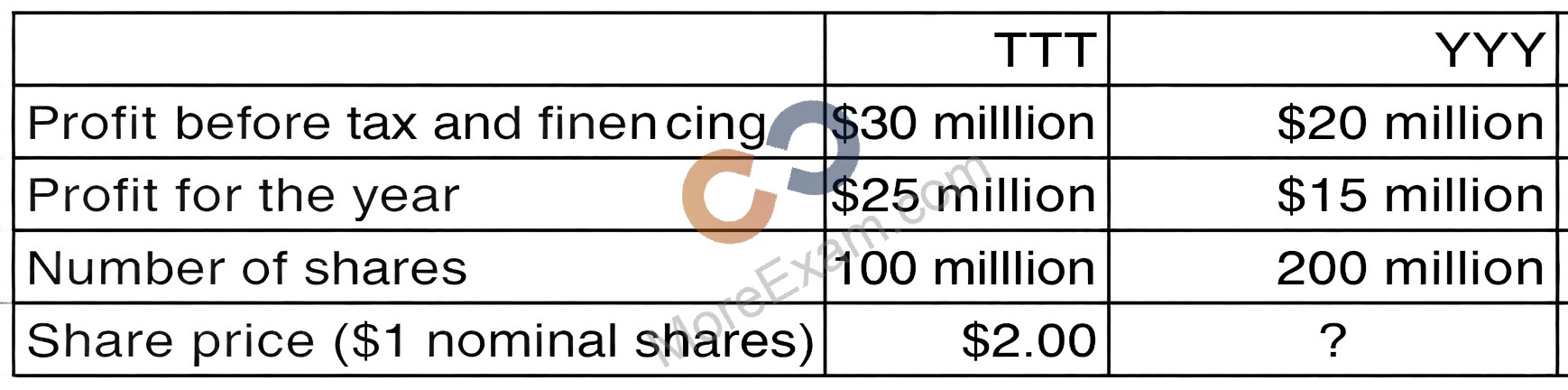
Question107: Two unlisted companies TTT and YYY are being valued. The companies have similar capital structures and risk profiles and operate in the same industry sector It is easier to value TTT than to value YYY because there have recently been several well-publicised private sales of TTT shares.
Relevant company data:

What is the best estimate of YYY's share price?